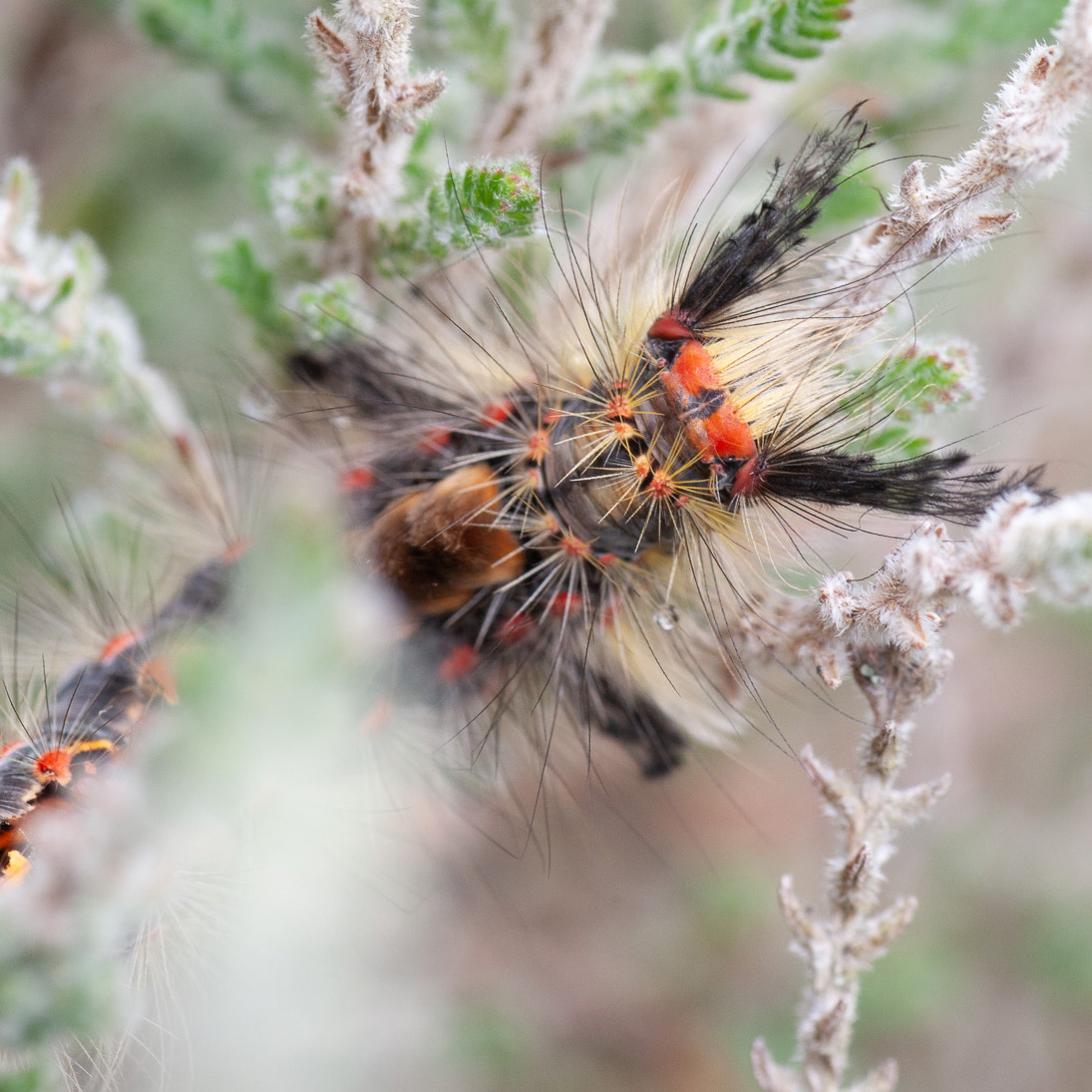
I always imagined it had dropped from the sky. Maybe a bird picked it up from one of the surrounding Cairngorm forests. On finding it a little too hairy for its taste, spat it out while flying over our garden in the heart of the town. Perhaps it fell to its new home, a lucky landing in a heather bush of pale mint stalks and purple flowers.
In my mind, this was the only way that it could have happened – the only way that my favourite caterpillar could have found its way to me. Virtually all our previous sightings of the creature were in the local woods, the site of our daily dogwalks.
Our first encounter with the Vapourer Moth was years earlier. We stared at the tiny dark thing, mere millimetres long, as it crawled across a piece of white paper on the dining table. I was fascinated by its punk hairdo – a line of four thick clumps of white hair sticking up from its black back. It seemed impossible that so small a thing could have such style – a mohawk in miniature. I loved it.
Garden habits
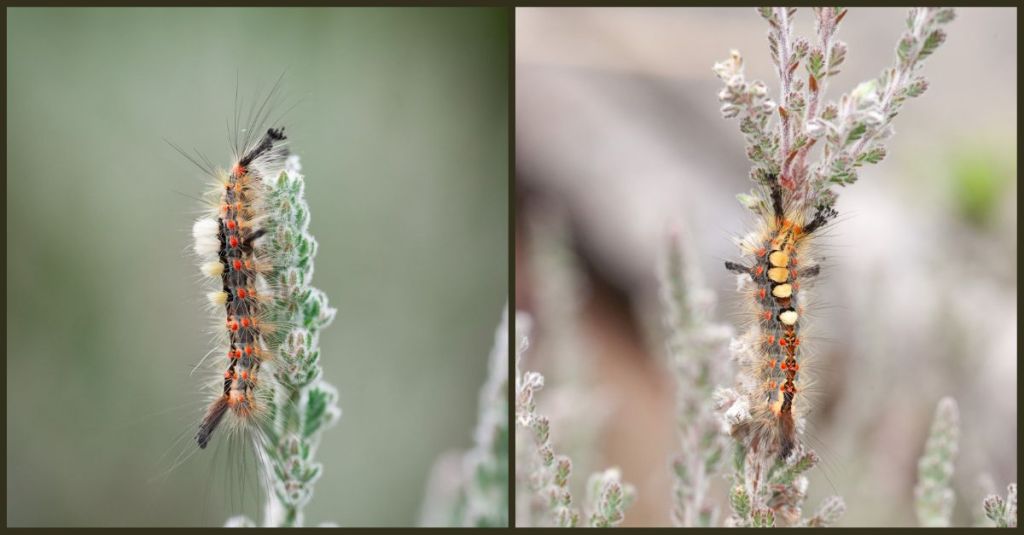
With one resident now in the garden, caterpillar-watching became an almost daily ritual. I may have been more obsessed than my two young sons. When we were leaving for school run, we looked for the caterpillar. When we returned in the afternoon, we looked for the caterpillar. As an amateur macro photographer, I documented its growth like I had documented the early years of those two boys. It was captured at different angles, in different light. In this way, I accumulated enough photos to fill a small album.
There was fear in those photos because each day we found it, we thought it would be the last. Surely a bird would discover it, one with a stronger stomach for spiky caterpillars.
But it kept chomping on the heather, growing and growing, turning its white mohawk into something darker. New spiky hairs grew all over the place and the red spots on its back morphed into black skulls with red eyes. Still punk. No bird could mess with it now.
With such striking colours, you’d expect to spot it easily but somehow it disappeared into the heather. We would stare at the stalks for ages until we finally spotted it.
One day, in July 2023, it disappeared. Unable to break the habit, we kept staring into the bush for weeks, with an idle hope of its triumphant return. We switched to catching grasshoppers in a meadow on the outskirts of town, the challenge of spotting and catching them more than enough to entertain two small boys.
Cocooning
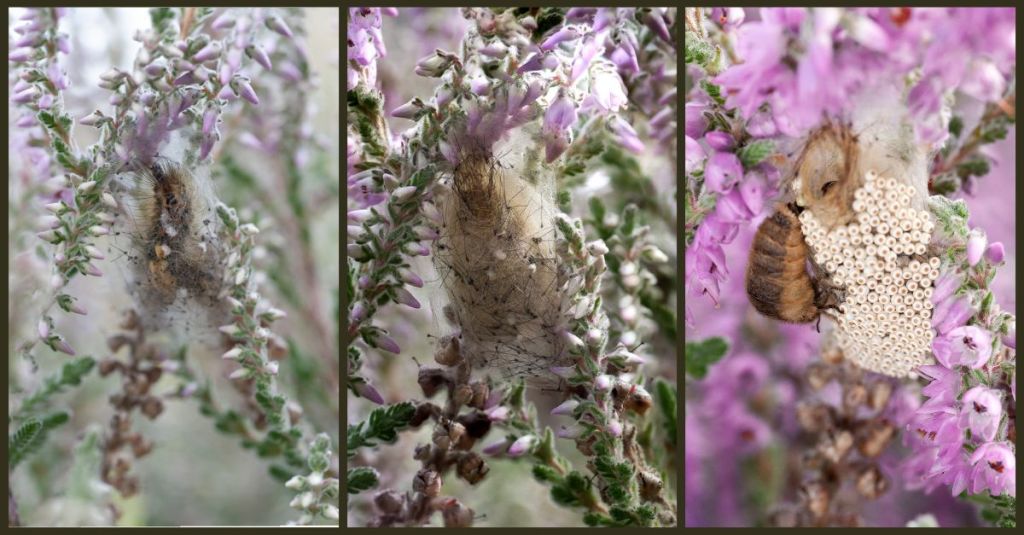
A few weeks later in August, while searching for wee heather bees in the garden, I glimpsed the Vapourer again. It was making its cocoon between the heather stalks, ironically, choosing to reappear to me just as it was about to disappear again. It wound its silk threads around itself, mixing in its own hairs, slowly becoming hidden from my view.
If it thought my interest would wane because it was in a cocoon, it was sorely mistaken. Because Vapourer moths are sexually dimorphic in an interesting way. The male is reddish brown with a white spot on each wing. He has hairy legs and huge comb antenna, flies by day.
The female is a totally different creature – a plump, furry thing with vestigial wings, leaving her flightless. Where she hatches, she stays and in the few days that she lives as an adult, she has to lure the male to her. And this is how the moth got its name – the female gives off pheromones, the vapours, to help a male to find her. After mating, she lays her eggs on her own cocoon.
Of course, amazingly for my obsession, ours hatched as a female. I caught her in the act of laying her last few eggs. She crawled over the silk for a few minutes, putting out these miniscule pale spheres over and over again. Each had a tiny target upon the surface.
She finally stopped, resting on the cocoon to die alongside her eggs.
A new start
The months rolled onwards. Autumn winds and the winter snow of the Cairngorms failed to dislodge the eggs. We continued our watch, a long watch this time.
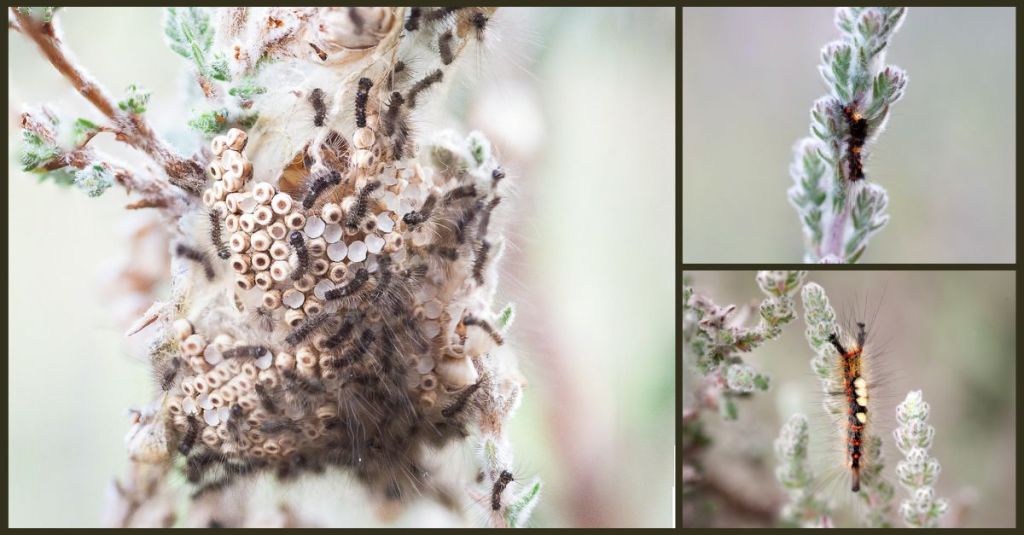
The day arrived in late May. I gave a shriek at finding the hatchlings emerging from their eggs. Tinier than you could ever imagine, yet so obviously hairy, they created a writhing black mass on the cocoon that had protected their mother.
Within days, they dispersed, vanishing into the garden. Our daily inspection found ten, then seven, five, all getting noticeably bigger on our heather bush. Another photo album was created for this brood from birth. There were high hopes for another look at the life cycle, perhaps even a female or two to reach adulthood and lay another brood. Perhaps we were a new hotspot for the Vapourer.
At time of writing, it seems unlikely. The five dwindled to three, sometimes just two as they disappeared and reappeared in the stalks. Then there was just one, large and spiky, the red warts large on its sides and the skull-like shapes evident on its back.
But it too has vanished. Perhaps it’s making a cocoon somewhere deep in the bush, away from our prying eyes.
Can’t shake the habit of looking though. If you see me lingering in the garden, kneeling on the path, beside the purple heather with camera in hand, you know I want just one more picture for the family album.
 Jane Candlish
Leave a comment